Mikita Tratseuski
1. Congratulations on your achievements in the NY Digital! Could you start by introducing yourself or your agency? Can you also share a bit about your journey into your current industry?
Thank you, I really appreciate it. My name is Mikita Tratseuski, and I am a Product Manager at BP Mobile (AIBY Group), a company that develops mobile solutions for everyday needs. My path into product management wasn’t linear, and that has shaped how I approach my work ever since. I’ve been a product manager for more than seven years, but I started my career in QA. Later, I moved into UX/UI design, which allowed me to see products from multiple perspectives. Each of those roles influenced how I think about product development. My time in QA taught me to recognize where users struggle and how even small issues can impact their experience. Design helped me understand how to solve user problems early, before development even begins. Eventually, I realized that product management was where everything came together. It’s about understanding users, seeing the product as a whole, and helping teams build solutions that are genuinely useful, intuitive, and easy to use.
2. What inspired you to submit your work for this competition, and what does winning mean to you personally and professionally?
For us, competitions like this are a way to benchmark our work against industry standards. We spend a great deal of time understanding our users—their context, motivations, concerns, and decision-making processes. The User Experience category was especially meaningful to us because it reflects how we actually build products. Winning is not the end goal for us. It is validation that our approach works. It shows our team—and the broader industry—that a strong product is about more than functionality or speed. It comes down to clarity, a sense of control, and genuine attention to the user.
3. Can you share the story behind your success? What inspired its creation, and what do you feel it represents in today’s industry?
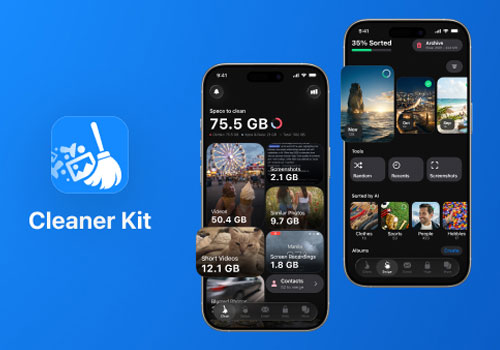
Cleaner Kit was built around a very clear but sensitive user need: helping people free up space on their iPhones without turning it into a stressful experience. For users, photos, videos, emails, and contacts are not just files—they are personal. So freeing up storage is not enough; it has to be done thoughtfully and with care for what is being removed. The product has been on the market for more than ten years, and during that time, we have learned a great deal from observing real user behavior. One key insight was that there is no universal solution in this category. You cannot reliably determine which photos matter to someone and which do not. That is why we built the product around user choice rather than automated deletion. We group similar photos, highlight the best shots, and provide warnings in sensitive cases. All of this helps simplify the process, but the final decision always remains with the user. I think this is what keeps the product relevant. Good UX today is not about making decisions for users—it is about giving them clarity and a sense of control.
4. What do you believe set your project apart in such a competitive field? Were there specific elements or strategies that made it shine?
Cleaner apps are indeed a very competitive category. Many players focus on the idea of instant results: press one button, and you’re done. It sounds appealing on the surface, but when it comes to personal content, that approach can feel risky. We took a different approach. Instead of pushing full automation, we focused on making a complex decision easier for the user. That meant a clear interface, large controls, alignment with system settings, and thoughtful features like grouping similar photos, highlighting the best shots, and adding warnings in sensitive cases. All of this is designed to make the experience more transparent and secure. For us, it was important that users feel in control, not pressured. I think that balance between efficiency and user control is what really made the difference.
5. Every project has its challenges. Can you share a significant obstacle you faced during this process and how you overcame it?
Probably the biggest challenge was finding the right balance between efficiency and trust. In this category, it is easy to make the experience feel faster through more aggressive automation, simpler content analysis, or more forceful deletion flows. But when you are dealing with personal photos, videos, and emails, that kind of speed can feel more like a risk than a benefit. That is why we were very careful about how the product works, including what it analyzes, how it groups content, when users need more context, and where the interface should be simpler and faster. It is a highly iterative process, involving extensive testing and close collaboration between product, design, and engineering teams. We also focused not just on efficiency metrics, but on whether users feel safe using the product. In the end, we were able to build an experience that helps people free up storage in a way that feels careful and respectful of their content.
6. Winning an award of this caliber often brings recognition. What do you hope this achievement will mean for your career, your team, or your agency in the long run? Have you already noticed any changes or opportunities arising from this recognition?
In the long run, I hope this award serves as confirmation that our approach to product development and user experience really works. For the team, it is a strong signal that the time and effort we invest in UX matters, and that it is recognized not just internally, but at the industry level as well. For BP Mobile (AIBY Group), it reinforces the idea that building a strong product is not just about functionality or speed. It is also about how well you understand the user and how consistently you translate that understanding into the product. Personally, I see this less as an end goal and more as a responsibility. It pushes me to keep raising the bar, pay closer attention to detail, and build solutions that are genuinely valuable to users and sustainable for the business.
7. What has the reaction been from clients, audiences, or stakeholders about your winning entry? Any feedback or memorable moments that stand out?
The reaction has been very positive, and what has been especially valuable is that people noticed not just the award, but the thinking behind it. Colleagues see that attention to the user is not just a talking point—it is what the product is built on. The most meaningful moments were within the team, when the people who put so much care and effort into this work saw it recognized externally. That kind of validation really matters.
8. For those aspiring to achieve similar success, what advice would you offer to help them not only thrive in their industries but also craft compelling, award-worthy entries? Are there specific practices, mindsets, or strategies you believe are key?
I’d focus on building something genuinely useful, not something that simply looks good in an awards competition. When your team truly understands the user’s problem, pays attention to detail, and makes deliberate decisions, it shows—both in the product itself and in the way you present it. When it comes to the submission, simplicity matters. Clearly define the problem, explain the thinking behind your decisions, and highlight the impact on the user experience.
9. The creative industry is constantly evolving. How do you view these changes, and where do you hope to position yourself in the future?
The industry is changing quickly, especially with the way AI is reshaping product development. But for me, the core principle has not changed. Technologies and trends only matter if they actually solve real user problems. I am not interested in novelty for its own sake. At BP Mobile (AIBY Group), we focus on building products where modern technologies make the experience clearer, more useful, and safer for users. Personally, I want to continue working at the intersection of product, UX, and business strategy, where these areas support one another rather than operate separately.
10. Entering awards can be daunting for many, especially those just starting out. What would you say to individuals who have limited experience, or are hesitant to showcase their work in competitions? How can they build confidence and see the value in participating?
I wouldn’t think of it as a competition you have to win. It is more about stepping back and looking at your work from a different perspective. It forces you to articulate what you have built, why it matters, and how you approach problems. That alone is valuable, especially early in your career. It also gives you a sense of where you stand and how your work compares with others in the field.
11. Creativity thrives on community. What message would you like to share with fellow creatives, marketers, and advertising professionals?
Don’t lose sight of the user amid all the metrics, trends, and technologies. It sounds obvious, but it is one of the hardest things to stay consistent with. The faster the industry moves, the easier it is to start optimizing for numbers instead of solving real problems. Just as importantly, value collaboration. The best solutions come from teams where design, engineering, and product do not just coordinate, but actually think through problems together. That is what leads to work that is difficult to replicate.
12. Winning is a team effort in many cases. Is there someone or a group of people you’d like to dedicate this achievement to, and why?
I’d start with the design team. A strong user experience comes from a great deal of research and careful thought—understanding the user, finding the right solution, and making sure it integrates naturally into the product. It takes time, and much of that work is not visible from the outside, but it is what truly shapes the product. And, of course, the development team as well. They are the ones who turn ideas into something reliable and fast that people can actually use. Without them, even the best UX ideas would not make it into the product.
13. If you could describe your award-winning entry in one sentence, what would it be and why?
Cleaner Kit helps you declutter your iPhone without risking what matters, because it keeps you in control of what gets deleted.
14. Finally, what’s next for you? Any exciting projects or upcoming goals that you’d like to share with us and the audience?
Right now, we’re expanding beyond a single-product focus. We’re continuing to improve Cleaner Kit while also exploring how it can support users’ broader digital environment, not just storage. There’s more to come.