Zhengyang Yang
1. Congratulations on your achievements in the NY Digital! Could you start by introducing yourself or your agency? Can you also share a bit about your journey into your current industry?
I’m Zhengyang Yang, a product and UX designer working at the intersection of emerging technologies and large-scale consumer platforms. I’ve designed experiences across AI, e-commerce, and Web3, including products used by billions of people worldwide. My journey began with a curiosity about how design can shape behavior at scale. Over time, I became particularly interested in systems where digital and real-world value intersect—whether in commerce ecosystems or decentralized networks. BioMatrix is a natural extension of that exploration.
2. What inspired you to submit your work for this competition, and what does winning mean to you personally and professionally?
I submitted BioMatrix because it represents a direction I deeply believe in—the convergence of identity, trust, and value in the digital age. Winning is meaningful not only as recognition, but also as validation that this space is ready for more human-centered design. Professionally, it reinforces my belief that designers can play a leading role in shaping the next generation of economic systems—not just interfaces.
3. Can you share the story behind your success? What inspired its creation, and what do you feel it represents in today’s industry?
BioMatrix was inspired by a fundamental question: How can we make digital value more meaningful and accessible in the real world? The project explores a future in which verified individuals can participate in a more equitable digital economy through mechanisms such as universal basic income, powered by blockchain technology and biometric verification. In today’s industry, it represents a broader shift—from speculative crypto-driven experiences to systems built on trust, identity, and real-world utility.
4. What do you believe set your project apart in such a competitive field? Were there specific elements or strategies that made it shine?
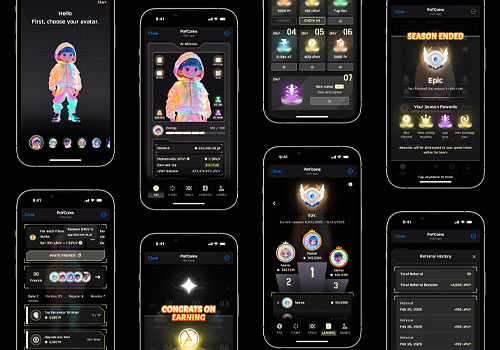
What set BioMatrix apart is its holistic system design. Instead of focusing only on tokens or infrastructure, we designed: - A human verification layer (biometric-based trust) - A value distribution mechanism (monthly UBI) - A consumption ecosystem (games, content, and apps) This end-to-end approach—combining technology, product design, and storytelling—allowed BioMatrix to stand out as a complete ecosystem rather than a single feature.
5. Every project has its challenges. Can you share a significant obstacle you faced during this process and how you overcame it?
One of the biggest challenges was designing trust within an inherently trustless environment. While blockchain systems are often technically secure, they can also feel complex, confusing, or intimidating to everyday users. We had to translate concepts such as identity verification and token economics into experiences that felt intuitive and approachable. We addressed this challenge by focusing on progressive disclosure—revealing complexity only when necessary—and grounding the experience in familiar digital behaviors.
6. Winning an award of this caliber often brings recognition. What do you hope this achievement will mean for your career, your team, or your agency in the long run? Have you already noticed any changes or opportunities arising from this recognition?
In the long run, I hope this recognition positions both BioMatrix and me as contributors to the evolving Web3 design landscape. Awards like this help bridge the gap between experimental ideas and mainstream adoption. While it is still early, the recognition has already sparked conversations with collaborators who are interested in building meaningful, real-world applications powered by emerging technologies.
7. What has the reaction been from clients, audiences, or stakeholders about your winning entry? Any feedback or memorable moments that stand out?
The most interesting feedback has centered around the human verification aspect of the project. Many people resonated with the idea that future digital economies need a reliable way to verify real human presence, especially in an era increasingly shaped by AI and automation. That feedback stood out to me because it reinforced the idea that the challenge we are addressing is both timely and necessary.
8. For those aspiring to achieve similar success, what advice would you offer to help them not only thrive in their industries but also craft compelling, award-worthy entries? Are there specific practices, mindsets, or strategies you believe are key?
I would encourage aspiring designers to focus less on trends and more on first principles. Ask yourself these questions: - What real problem are you solving? - Why does it matter now? - How does your design create tangible value? From a craft perspective, strong storytelling is key. The best award-winning work is not only well designed—it also communicates a clear vision.
9. The creative industry is constantly evolving. How do you view these changes, and where do you hope to position yourself in the future?
The industry is moving toward systems thinking. Designers are no longer just shaping interfaces—they are shaping ecosystems, economies, and behaviors. As AI and blockchain continue to accelerate this shift, the role of design becomes increasingly strategic. I hope to position myself at the forefront of this transition, working on products that combine large-scale impact with meaningful innovation.
10. Entering awards can be daunting for many, especially those just starting out. What would you say to individuals who have limited experience, or are hesitant to showcase their work in competitions? How can they build confidence and see the value in participating?
Don’t wait until your work feels “perfect.” Competitions are not just about winning—they are about articulating your ideas, refining your thinking, and putting your work out into the world. Even early-stage projects can stand out when they present a strong point of view. Confidence comes from participation, not the other way around.
11. Creativity thrives on community. What message would you like to share with fellow creatives, marketers, and advertising professionals?
We’re entering an era where technology is evolving faster than our frameworks for understanding it. As creatives, we have a responsibility not only to build what’s possible, but also to question what’s meaningful. The future will be shaped by those who can bridge innovation with human values.
12. Winning is a team effort in many cases. Is there someone or a group of people you’d like to dedicate this achievement to, and why?
I’d like to dedicate this recognition to the broader community of designers and builders exploring the intersection of Web3 and real-world impact. It is a space filled with uncertainty, but also immense possibility—and every experiment helps shape what comes next.
13. If you could describe your award-winning entry in one sentence, what would it be and why?
BioMatrix is a human-centered blockchain ecosystem that transforms digital identity into real-world value through trust, accessibility, and meaningful participation.
14. Finally, what’s next for you? Any exciting projects or upcoming goals that you’d like to share with us and the audience?
I’m continuing to explore how large-scale platforms and emerging technologies can converge. My focus is on building products that not only reach millions—or even billions—of users, but also redefine how value, identity, and opportunity are distributed across the digital world.